
July 21, 2026
Playing the Strategic Game: Using Football to Disrupt Violence Against Women and Girls (VAWG)
The United Kingdom has long been teetering on a pivotal, uncomfortable, edge regarding Violence Against Women and Girls (VAWG). Since the high-profile tragedies of 2021, the national consciousness has remained volatile. The focus has shifted from “How do we stay safe?” To “How can we work to change the culture that allows VAWG to happen?”
VAWG is far beyond a series of isolated criminal incidents; it is a public health epidemic. One in five women in the UK experience sexual assault in their lifetime. During the pandemic, these figures intensified, leading some experts to label VAWG as “the shadow pandemic.”
However, as the criminal justice system struggles, the focus must shift toward prevention. Specifically, we must look at where the roots of these behaviours are watered.
The Cultural Weight of the Pitch: Sport and Masculinity
Football is more than just a game in the UK; it is a cultural cornerstone. It defines the mainstream and provides a space where traditional models of masculinity are not only expressed but celebrated. Unfortunately, research has long noted an intersecting association between certain sports settings and “hegemonic masculinity”: social norms that can, if left unchecked, reproduce violence-supportive attitudes.
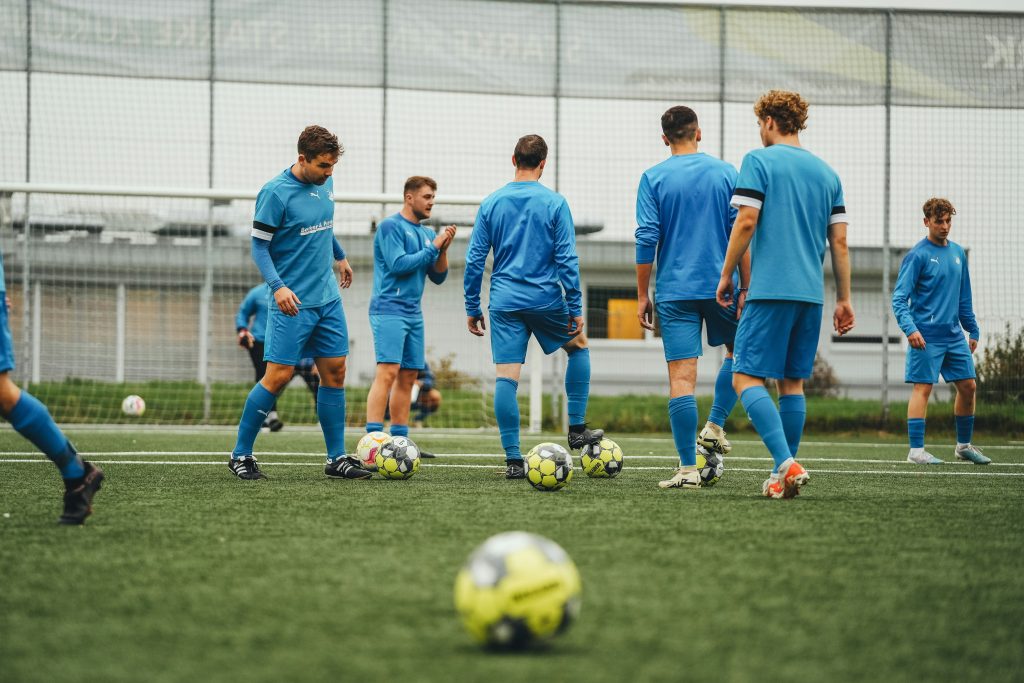
This is the case on an individual level (male college athletes can show a higher affinity for “rape myth acceptance”) and in groups (data suggests a correlation between high-stakes football matches and spikes in reported domestic violence cases).
Sports clubs are simultaneously “at-risk” environments, and critical spaces for prevention.
Shifting the culture within a football club can shift the culture of a community.
Football Onside: An Intervention
At the heart of a research paper (Kovalenko & Fenton, 2024, Journal of Interpersonal Violence) is Football Onside, a transformative bystander leadership program. Unlike “off-the-shelf” training, Football Onside was designed specifically for the professional football environment, acknowledging the unique social bonds and hierarchies within a club.
The program is built on a sophisticated framework that moves beyond simple awareness. It uses two primary psychological models to drive behaviour change:
1. Latané and Darley’s Situational Model
This model explains the decision-making process of a bystander. To move someone from a “passive observer” to an “active intervenor,” they must successfully navigate five stages:
- Notice the event (recognising a comment or action as it happens).
- Identify it as problematic (breaking through the “locker room talk” excuse).
- Assume responsibility (realising that if they don’t speak up, no one will).
- Gain the skills to act (knowing how to intervene safely).
- The Intervention (the actual act of disruption).
Read more about the bystander approach here.

2. Prochaska and DiClemente’s Stages of Change
Behaviour change is rarely linear. This model acknowledges that participants may start in “pre-contemplation” (denying there is a problem) and move through “contemplation” and “preparation” before taking action.
By using this framework, Football Onside “meets participants where they are” – rather than assuming everyone is already ready to lead.
The Research: An Experimental Deep Dive
To test the efficacy of this approach, Kovalenko & Fenton conducted a feasibility study in South West England involving football coaches and club members. This wasn’t a one-off workshop; it was a rigorous evaluation using an intervention group and a control group, with a nine-month follow-up period.
Methodology and Fidelity
One of the most significant challenges in “culture change” training is fidelity: ensuring the program is delivered exactly as intended. Trainers were recruited from, or recommended by, local victim organisations and put them through intensive training with the academics who designed the program.
Several key metrics were measured:
- Rape Myth Acceptance (RMA): Belief in false narratives that shift blame from the perpetrator to the victim.
- Domestic Abuse Myths (DVMA): Misunderstandings regarding the dynamics of control and violence.
- Bystander Intent and Efficacy: The willingness and perceived ability to step in.
- Perception of Peer Norms: What they think their teammates believe (often vastly different from reality).

Key Findings: Do Bystander Programs Work?
The results of the nine-month study provided promising evidence that is vital for any institution considering similar programs.
1. The Death of the Myth
Kovalenko & Fenton observed significant, long-term improvements in the rejection of rape myths and domestic abuse myths. This is crucial because these myths act as the “scaffolding” that supports violent behaviour. When a coach or a senior player stops believing that “she was asking for it” or “it’s just a private matter,” the social permission for that behaviour vanishes.
2. The Gap Between “Intent” and “Action”
Interestingly, the study showed a significant increase in Bystander Intent and Efficacy. Participants felt more confident and wanted to intervene more. “Actual helping behaviour ” (the physical act of stepping in) showed an upward trend but wasn’t as statistically significant.
One takeaway: Confidence is built in the classroom, but action is built through sustained culture.
Participants need time and repeated opportunities to practice these skills in the real world before they become second nature.
3. The Power of “Buy-In”
The feasibility of the program was heavily influenced by the “buy-in” from leadership. In cases where the CEO of the Club Trust presented the training as a core staff responsibility, engagement was significantly higher. This reinforces the idea that culture change must be top-down as well as bottom-up.
Implications for Higher Education: Meeting Condition E6
For higher education leaders, this research is a useful guide to answering the Office for Students (OfS) Condition E6 requirements. The OfS is clear: training must be evidence-led, rigorously evaluated, and designed by experts.
The sports setting learnings are highly applicable to universities with their concentration of sports teams and, in some cases, professional or semi-professional athletes.
Football Onside research also underlines some helpful reminders for universities and colleges:
- Move beyond the “performative masculinities” present in student societies and sports teams.
- Deliver to a cohesive peer group (like a sports team or a department) for higher efficacy compared to “open-invite” sessions.
- Success can’t be measured by satisfaction after the session; attitude change should be recorded over the following months.
Addressing the Backlash
A common concern with this type of transformative training is the risk of “backlash”. Men might feel targeted or silenced, leading to the opposite of the desired effect in behaviour change.
Kovalenko & Fenton, 2024, found very few instances of this. In fact, by positioning men as “social justice allies” rather than “potential perpetrators,” the program fostered a sense of community and responsibility.
Crucially, a bystander approach doesn’t tell people what to think; it provides them with the evidence and the skills to ensure their community is safe and respectful.
Conclusion: A Call to Leadership
The evidence shows that bystander intervention works, but it isn’t a quick fix. For long-entrenched societal issues, it is unlikely that we will ever find a quick fix. It requires an investment in academic credibility, expert delivery, and long-term monitoring.
Whether you are running a Premier League Community Trust or a major UK University, the take-home message is the same: don’t wait for a crisis.
Implement evidence-led programs like Lead the Change HE to go beyond a regulatory requirement. Build a culture where every student, staff member, and athlete can thrive in safety.